Case File 002: Diamond Rice
A Baltimore native and youth advocate devoted to helping others is killed in Cincinnati. The timeline raises questions that still demand answers.
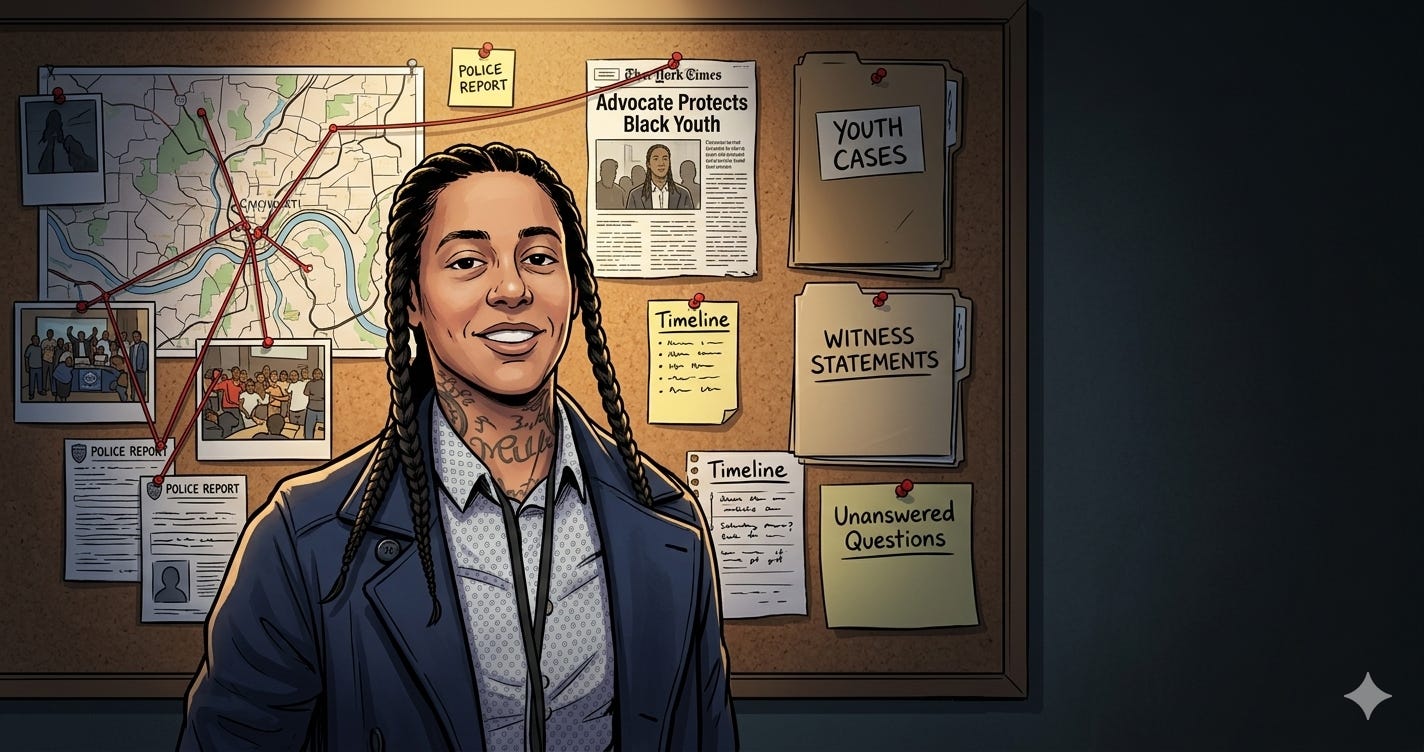
On the night of February 1, 2026, the quiet streets of Walnut Hills in Cincinnati were interrupted by flashing police lights.
Just after 10 p.m., officers responded to reports of a shooting on the 2300 block of May Street.
When they arrived, they found Diamond Rice, 33 years old, suffering from a gunshot wound.
Paramedics attempted to save her.
But it was already too late.
Within hours, her significant other — Jasmine Blake, 31 years old — was taken into custody and later charged with murder.
By the next morning, the story had already begun to circulate through news alerts and social media posts.
But behind the police reports and court filings lies a far deeper story — one about a woman whose life was defined not by violence, but by her desire to help others.
Who Diamond Was
Before her name appeared in crime headlines, Diamond Rice was known for something very different.
She was known for care.
Rice was a Baltimore native who had moved to Cincinnati in recent years while building a life centered around advocacy and service.
She worked with Youth Advocate Programs, an organization that supports young people involved in the justice system. Her role placed her alongside youth navigating some of the most difficult circumstances imaginable — court involvement, unstable home environments, and systemic barriers.
Friends and colleagues described her as someone who met those challenges with compassion.
She believed deeply in the idea that people deserve second chances.
That belief did not come from theory.
It came from experience.
Like many people working in youth advocacy, Diamond understood struggle from the inside. Earlier in her life, she had faced her own challenges and had made choices she later worked hard to move beyond. Those experiences shaped the way she connected with the young people she served.
She could relate to them in a way that many adults could not.
She understood what it meant to feel stuck.
She understood what it meant to want a way out.
And because of that, she wanted to help guide young people away from the same pitfalls she had encountered.
At the same time, Rice was pursuing a degree at Northern Kentucky University, studying toward a career in social work.
According to those who knew her through the university community, she had earned recognition on the President’s Honors List, a reflection of both her academic dedication and the direction she was determined to take her life.
The path she was building for herself was clear:
education
advocacy
service
She was working toward a future devoted to helping others navigate hardship.
Which makes what happened next all the more devastating.
The Night on May Street
According to police reports cited in local news coverage, the fatal shooting occurred during a confrontation between Diamond Rice and Jasmine Blake inside a residence on the 2300 block of May Street in Cincinnati’s Walnut Hills neighborhood.
Investigators allege Blake used a handgun during an argument.
Rice was struck and died at the scene.
Blake was arrested shortly afterward and charged with murder.
During early court proceedings, Blake’s attorney argued that the shooting occurred in self-defense, claiming Blake feared for her life.
Prosecutors, however, stated that investigators did not find evidence suggesting Rice posed a threat that justified deadly force.
Those competing claims now form the central legal tension of the case.
But the timeline surrounding that night raises questions that have yet to be fully answered.
Several Cincinnati locals have reported seeing Diamond Rice earlier that evening at Good Brothers Bar & Grill, a neighborhood hangout spot where she was reportedly seen after 9:00 p.m.
The bar is located roughly nine miles from May Street, a drive that typically takes around 30–35 minutes depending on traffic.
Police records indicate that 911 was called by Jasmine Blake, and officers arrived at the residence at approximately 10:15 p.m.
When placed side by side, the timeline becomes strikingly narrow.
If Rice was indeed seen at the bar shortly after 9 p.m., that leaves a limited window of time for her to leave the location, travel across the city, arrive at the residence on May Street, and become involved in a confrontation serious enough to end in gunfire.
What happened in that window of time remains unclear.
During the 911 call, Blake reportedly told dispatchers that she believed Rice was going to kill her. At one point in the call, Blake also stated that “she’s gone,” referring to Rice being deceased.
Whether those statements reflect fear, panic, or an attempt to frame the events of the night will ultimately be examined through the court process.
But the compressed timeline raises difficult questions.
Did the argument begin before Rice arrived at the residence?
Was the conflict already escalating earlier in the evening?
Or did something happen in those final minutes that turned an argument into a fatal shooting?
Some observers have also questioned whether the call to police was made in an attempt to document a self-defense narrative.
At this stage, however, those questions remain unanswered.
What is certain is that sometime between the end of a night out and the arrival of police on May Street, Diamond Rice lost her life.
And the truth of what happened in those final moments now rests in evidence that has yet to be fully revealed.
A Family’s Grief
For Wanda Sommonds and Scott Rice, the news arrived in the most devastating way imaginable.
A phone call in the early morning hours.
A message no parent ever expects to receive.
Their daughter — Diamond Rice — was gone.
In interviews following her death, Sommonds described Diamond as someone who cared deeply about others and who was committed to helping young people avoid the kinds of hardships she herself had experienced growing up.
Her life, her mother said, was meant to make a difference.
Diamond’s father, Scott “DJ Scottie B” Rice, is a well-known figure in Baltimore’s music community. Behind the reputation and the recognition, however, he is first and foremost a father grieving the loss of his child.
Friends and community members say the pain of Diamond’s death has reverberated deeply throughout Baltimore — not only because of who her parents are, but because of the kind of person Diamond herself had become.
A woman trying to build something better.
A woman working to help others.
Now, instead of celebrating her future, her parents are left fighting to ensure that her death does not fade quietly into another forgotten headline.
Their message has been clear.
They want answers.
And above all, they want justice.
A Community Responds
Diamond’s death reverberated far beyond Cincinnati.
Back in Baltimore, friends, relatives, and community members gathered for a vigil in her honor.
Candles flickered in the winter air.
Photos of Diamond were held close.
Stories were shared about the woman people knew — the one who made people laugh, checked in on friends, and carried herself with a quiet sense of determination.
For many in attendance, the vigil was both mourning and protest.
A refusal to allow Diamond’s name to disappear.
Across social media, thousands of posts from family members, friends, and loved ones began to appear. Many described Diamond as compassionate, loyal, and deeply committed to helping others.
But as the conversation spread online, not every voice followed the same narrative.
Under a post about the case on the popular Baltimore crime page @murder_ink_bmore, an Instagram user identified as @hairslayyerr wrote:
“I know them both personally so stop speaking on what you don’t know!!! Y’all so quick to hop on a narrative because of what it looks like. Get the facts straight first and foremost.”
The comment quickly caught attention.
It suggested that the situation between Diamond Rice and Jasmine Blake may be more complicated than what early reports have described.
At this stage, however, there is no public confirmation that the user personally knew either woman, nor is there independent verification of what they may have been referring to.
Still, statements like this highlight something that often happens in cases like these.
When tragedy unfolds, two narratives begin to emerge.
The official version, built from police reports and court records.
And the community version, shaped by the people who knew those involved.
Sometimes those two stories align.
Sometimes they do not.
In the case of Diamond Rice, the truth of what happened that night on May Street may ultimately lie somewhere between them.
And until the full evidence is presented in court, many of the questions surrounding her death remain unanswered.
The Questions That Remain
Like many homicide cases still moving through the courts, the death of Diamond Rice leaves behind a trail of unanswered questions.
Not small questions.
Not simple ones.
But the kind of questions that sit heavy in the space between what is known and what has yet to be revealed.
What exactly happened inside that residence on May Street in the minutes before the gun was fired?
What words were spoken?
What emotions were escalating behind closed doors?
Was this a sudden eruption of conflict — the kind that spirals out of control in a matter of seconds — or was the tension already building long before that night?
The timeline itself raises difficult possibilities.
If Diamond Rice was seen earlier that evening at Good Brothers Bar & Grill, roughly nine miles away from the location where she was killed, what happened in the time between her leaving that bar and the moment police arrived at the scene?
Did the argument begin before she even reached the residence?
Was there already a confrontation waiting for her when she walked through the door?
Or did something change in those final moments — a misunderstanding, a fear, a decision made too quickly — that turned an argument into a tragedy that cannot be undone?
Then there is the 911 call.
When Jasmine Blake contacted dispatchers, she reportedly told them she believed Rice was going to kill her.
At another point during the call, Blake said “she’s gone,” referring to Rice being deceased.
Those words will almost certainly be dissected in court.
The timing of the call.
The tone of the voice.
The moments before and after those statements.
Every second may matter.
Because in homicide cases, the truth often hides inside the smallest details.
What evidence will prosecutors present to explain what happened in that room?
Were there witnesses nearby who heard anything that night?
Were there prior conflicts between the two women that could shed light on what led to this moment?
What physical evidence was recovered from the scene?
And perhaps most critically — what will the defense present to support its claim of self-defense?
Self-defense cases hinge on perception.
Fear.
Immediacy.
The belief that deadly force was necessary to survive.
Whether that belief existed — and whether the law ultimately considers it justified — will likely become the central battleground of this case.
But beyond the courtroom arguments lies another layer of truth that cannot be measured by legal standards alone.
The truth of a life that ended.
The truth of a family now living with an absence that will never be repaired.
The truth of a community asking how a woman remembered for compassion and service could lose her life in a moment that remains so deeply unclear.
The answers to these questions may take months — perhaps even years — to fully emerge.
Courtrooms move slowly.
Evidence takes time to surface.
Witnesses take time to speak.
But the search for truth has already begun.
And for those who loved Diamond Rice, that search is not just about understanding what happened.
It is about making sure that her story — and the truth behind it — is never allowed to disappear.
Why This Case Matters
Cases like this often risk becoming statistics.
A number added to a homicide report.
A headline that flashes across a screen for a few hours before disappearing beneath the next breaking story.
Another name that people scroll past without ever learning who that person truly was.
But when a life is reduced to a statistic, something important is lost.
Because statistics do not capture laughter.
They do not capture the way someone shows up for their friends.
They do not capture the late-night phone calls between parents and their children, the dreams someone was quietly building, or the small acts of kindness that never make it into police reports.
Statistics cannot tell you who Diamond Rice was.
They cannot tell you that she was working with young people who needed guidance.
They cannot tell you that she was studying to become someone who could help others rebuild their lives.
They cannot tell you that she understood struggle because she had lived through it herself — and that she chose to turn that experience into compassion instead of bitterness.
They cannot tell you what it means for a mother to wake up every day knowing her daughter will never call again.
Or what it means for a father to carry the weight of a child he loved deeply now gone forever.
And they certainly cannot explain how a life devoted to helping others can end in a moment of violence that still leaves more questions than answers.
When a story like Diamond Rice’s fades into the background, something larger fades with it.
The opportunity to ask harder questions.
The opportunity to examine what led to that moment.
The opportunity to ensure that the people behind these cases are remembered as human beings — not just case numbers.
That is why this case matters.
Not only because someone has been charged.
Not only because a court will eventually decide what happened that night.
But because Diamond Rice’s life was larger than the moment that ended it.
And stories like hers deserve to be remembered long after the headlines move on.
Case Summary
Victim: Diamond Rice
Age: 33
Date of Death: February 1, 2026
Location:
2300 block of May Street
Walnut Hills – Cincinnati, Ohio
Defendant Charged:
Jasmine Blake, 31
Charge: Murder
Case Status: Active criminal case
A Note From Exhibit Black
The truth about what happened on May Street will eventually be argued in a courtroom.
Evidence will be presented.
Testimony will be examined.
A legal conclusion will be reached.
But long before that verdict is ever spoken, one fact remains unchanged.
Diamond Rice was here.
Her life mattered.
And her story will not be forgotten.
This case remains open.
And Exhibit Black will continue to follow it.
Where Evidence Speaks.
— Exhibit Black Case Files