Case File 001: Tanisha Hope Allen
Baltimore, Maryland — December 18, 1992
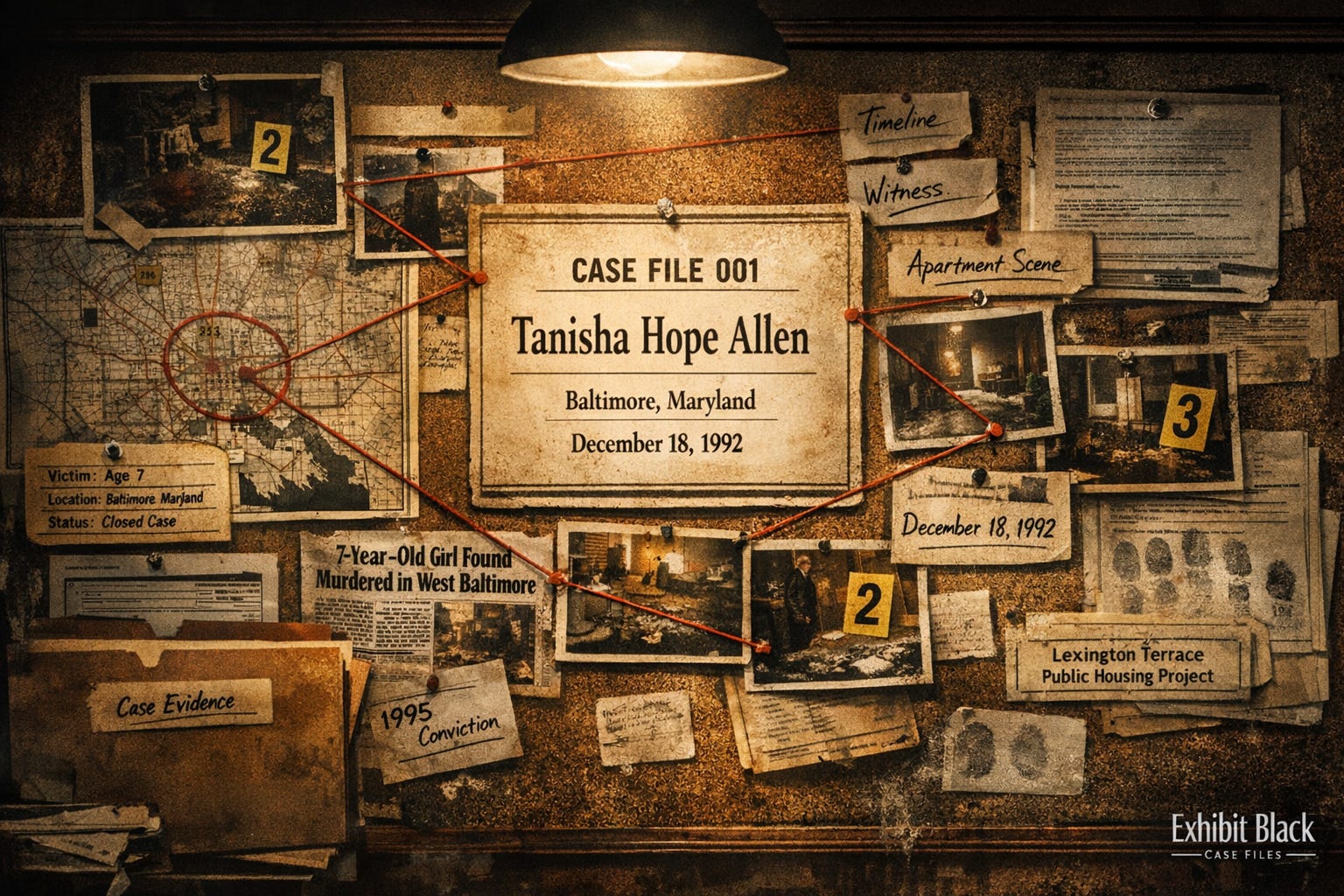
CASE FILE 001
On the morning of December 18, 1992, a seven-year-old girl named Tanisha Hope Allen was found dead inside her family’s apartment at the Lexington Terrace public housing complex in West Baltimore.
She lived on the 14th floor of 221 North Fremont Avenue, in a building where families raised children, neighbors knew each other by name, and kids played in the hallways after school.
That morning should have been ordinary.
Instead, it became the beginning of one of the most disturbing crimes Baltimore had seen involving a child.
Tanisha had been sexually assaulted and murdered inside her own home.
There were no clear signs of forced entry, although investigators noted a broken window. The circumstances raised immediate questions:
Who had access to the apartment?
Who had been there that night?
And how could something so horrific happen without anyone stopping it?
Within months, three men were charged in connection with the crime.
In 1995, Lamell Dixon and William Holland were convicted of first-degree rape and murder and sentenced to life in prison.
But the case did not unfold without controversy.
A neighbor, Raychella Smith, testified that she witnessed the assault while inside the apartment attempting to retrieve an item from Tanisha’s mother.
Tanisha’s mother, Peggy “Cookie” Allen, was initially charged as an accomplice. Prosecutors later dropped the charge due to lack of evidence, and she ultimately testified during the trial.
Even after the convictions, questions lingered about the timeline of events, witness testimony, and what exactly happened inside that apartment.
More than thirty years later, Tanisha’s name rarely appears in conversations about Baltimore’s history.
Her story is mostly reduced to a few paragraphs on the internet — a short record of a brutal crime against a child who deserved a lifetime.
But cases like this deserve more than a few paragraphs.
They deserve to be documented.
They deserve to be remembered.
And they deserve to be examined carefully, piece by piece, so that the full story is never lost.
Why This Case Matters
Tanisha Hope Allen was seven years old.
She was someone’s sister.
Someone’s neighbor.
Someone’s friend.
A child who should have been safe in her own home.
Her case reflects something larger that continues to happen across the country:
Stories involving Black victims — particularly Black children — often fade from public memory far too quickly.
Exhibit Black exists to prevent that from happening.
Through case timelines, evidence analysis, court records, and investigative storytelling, this publication will document cases that deserve deeper examination and permanent record.
Some of the cases we cover will be solved.
Some will remain unanswered.
Some may reveal details that were never widely reported.
But each case will be approached with the same goal:
To preserve the truth of what happened.
The Investigation Begins
Over the coming weeks, Exhibit Black Case Files will examine the Tanisha Hope Allen case in detail, including:
• The timeline of December 18, 1992
• The Lexington Terrace apartment scene
• The investigation and arrests
• Trial testimony and witness accounts
• Court records and sentencing
• The lasting questions surrounding the case
Where possible, we will also obtain official documents and records related to the investigation.
Because every case deserves more than a headline.
It deserves a record.
In loving memory of:
Tanisha Hope Allen
Baltimore, Maryland
January 8, 1985 — December 18, 1992
This investigation is apart of the Exhibit Black Case Files archive documenting criminal cases, missing persons, and overlooked injustices involving Black victims and communities. If you believe a case deserves attention, you can submit information to the Exhibit Black tip line, (307) 205-6517.
Subscribe to receive updates as this investigation continues and to be notified of future investigations.
Exhibit Black Case Files
Where Evidence Speaks.